








Most people never wake up one morning and simply decide to leave their home. The question creeps in after a fall, a scary night alone, or a grown child who keeps asking whether everything is really fine. If you are weighing aging in place vs assisted living right now, you need a way to compare the two that goes beyond gut feeling, and that is what this guide gives you.
Below are the questions that actually settle the decision: how much help is needed, what each path costs where you live, whether the house can adapt, and how your state treats your home if Medicaid ever enters the picture. Work through them in order and the answer usually gets much clearer. It also helps to go through them with the people who would share the load, because their honest input matters as much as yours.
Start With the Level of Care, Not the Address
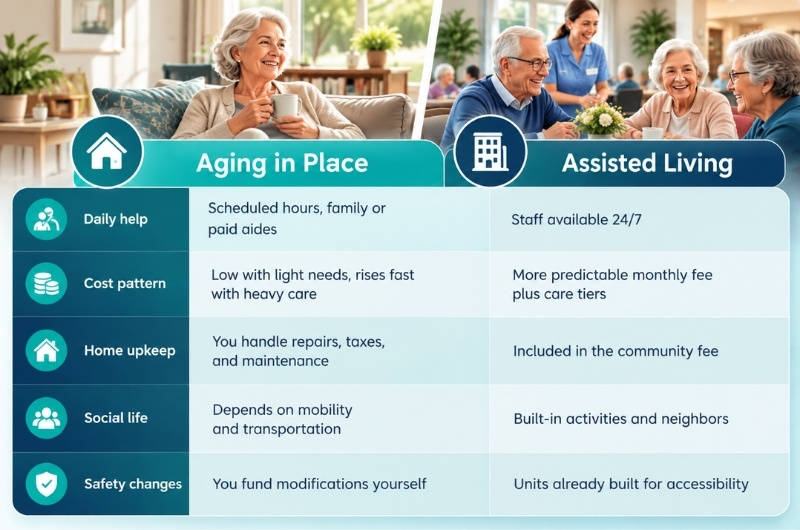
The house is rarely the real question. What decides this is how much daily help a person needs, how fast that need is growing, and whether anyone can reliably provide it. Write down every task that has become hard, from bathing and medications to driving, cooking, and paying bills, and note who handles each one today.
When Staying Home Still Works
Aging at home tends to work well when help is needed for a few hours a day rather than around the clock. The person can still call for help, manage medications with simple reminders, and get out of the house safely. There is also a family member, neighbor, or paid aide who can show up on a predictable schedule without burning out.
When the Balance Tips Toward Assisted Living
The picture changes when needs appear at unpredictable hours, like nighttime wandering, repeated falls, or missed doses that lead to hospital visits. Family caregivers who are exhausted, living far away, or juggling full-time jobs are another warning sign. If several of these 12 signs an older parent may need round-the-clock care sound familiar, it is time to treat assisted living as a real option rather than a last resort.
If you are not sure, and need more information about assisted living, this video might help.
Compare the Real Monthly Math
Staying home looks cheaper because the mortgage may be paid off, but that only holds while care needs stay light.
According to the CareScout 2025 Cost of Care Survey, the national median for assisted living reached $74,400 a year, while in-home homemaker services at 44 hours a week came to $80,080.
In other words, once paid help becomes close to full time, the home option can overtake assisted living before you even count property taxes, insurance, repairs, and utilities.
Where you live changes this math dramatically. In Wyoming, full-time homemaker care runs about $105,248 a year compared with $63,900 for assisted living, so staying home with heavy support is the pricier choice by a wide margin. Hawaii sits at the other extreme, with assisted living at about $145,155 a year, nearly three times the Mississippi median of $52,425.
One more detail catches many families off guard. Medicare does not pay for long-term custodial care, whether you receive it at home or in an assisted living community. That means most families pay from savings, long-term care insurance, veterans benefits, or eventually Medicaid.
| Factor | Aging in Place | Assisted Living |
|---|---|---|
| Daily help | Scheduled hours, family or paid aides | Staff available 24/7 |
| Cost pattern | Low with light needs, rises fast with heavy care | More predictable monthly fee plus care tiers |
| Home upkeep | You handle repairs, taxes, and maintenance | Included in the community fee |
| Social life | Depends on mobility and transportation | Built-in activities and neighbors |
| Safety changes | You fund modifications yourself | Units already built for accessibility |
Check Whether the House Can Keep Up
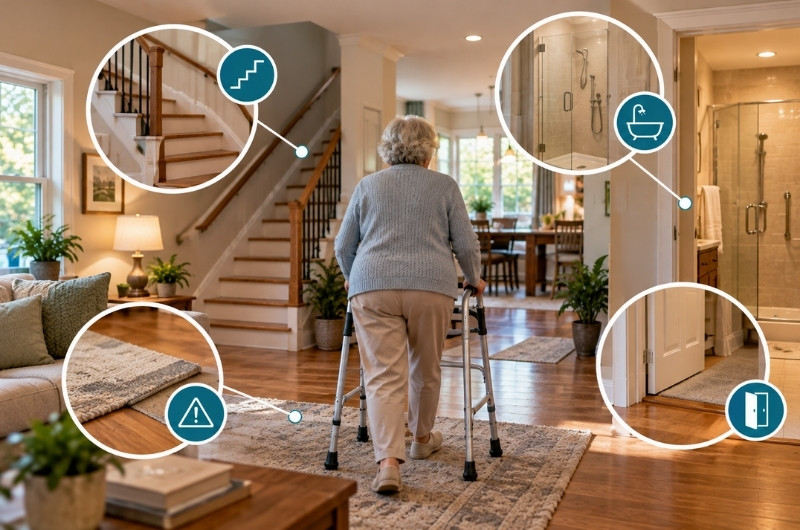
A home that worked perfectly at 65 can turn into an obstacle course at 80. The CDC reports that more than one in four adults aged 65 and older falls each year, and about 37% of those who fall end up with an injury that needs treatment or limits their activity. Stairs, a tub you have to step over, narrow doorways, and poor lighting are the usual suspects.
Walk through the house as if you were using a walker or wheelchair. Can you get from the bed to the bathroom without steps? Is there space for a walk-in shower, a ground-floor bedroom, or a ramp at the entrance?
Before calling contractors, it helps to have accurate floor plans, and many families start with home drawings from Get A Site Plan so they can see what fits before any wall comes down.
If the answers point to expensive structural changes, or the layout simply cannot be fixed, that is valuable information too. Spending heavily on a house that still will not be safe rarely makes sense. Sometimes the most honest result of a home review is a decision to move sooner rather than later.
Know How Your State Treats Your Home and Savings
Medicaid is the biggest payer of long-term care in the country, and its rules on your home vary by state.
For 2026, the federal home equity limit for long-term care eligibility is $752,000, and states may choose a higher limit of up to $1,130,000, as Justice in Aging explains.
A dozen jurisdictions use the higher figure, while most stick to the minimum, and a new federal law will cap all states at $1 million starting in 2028.
The gap between states can be striking.
Wisconsin had a fixed limit of $750,000 that fell below the 2026 federal minimum, so the state had to raise it to $752,000.
A homeowner with the same house would be treated very differently in a state using the top limit, which is why planning ahead matters.
Assisted living coverage under Medicaid also differs, since many states only pay for care services through waiver programs and not for room and board. If there is any chance you will need help paying for care, read up on how Medicaid planning protects your home and savings and talk to an elder law attorney licensed in your state. Doing this before a crisis gives you far more options.
Weigh the Social Side Honestly

Loneliness is one of the quieter costs of aging in place. When driving stops and friends move or pass away, a familiar house can become an isolating one. Assisted living offers meals with neighbors, activities, and staff who notice when someone seems off, which matters more than many people expect.
On the other hand, plenty of older adults thrive at home with a strong local network. Church groups, senior centers, nearby relatives, and good neighbors can fill the gap.
Family dynamics deserve the same honesty. If one adult child is carrying everything, the setup is fragile no matter how much everyone loves Mom or Dad. It helps to sort out how siblings can share caregiving responsibilities more fairly before you decide that staying home is sustainable.
Test the Middle Ground First

This choice does not have to be all or nothing. Adult day programs, part-time aides, meal delivery, and medical alert systems can stretch the time someone safely spends at home. Trying a few of these for a couple of months shows you quickly whether home care can realistically keep up.
Veterans should look into VA benefits before ruling anything out. Programs covering home care services for veterans can pay for aides, respite care, and support for family caregivers. For some households, that support is what makes staying home affordable.
A short respite stay in an assisted living community is another smart test. Many communities offer stays of a few weeks, which lets a parent experience daily life there without committing. People are often surprised by how much they enjoy the company, and others confirm that home really is the better fit.